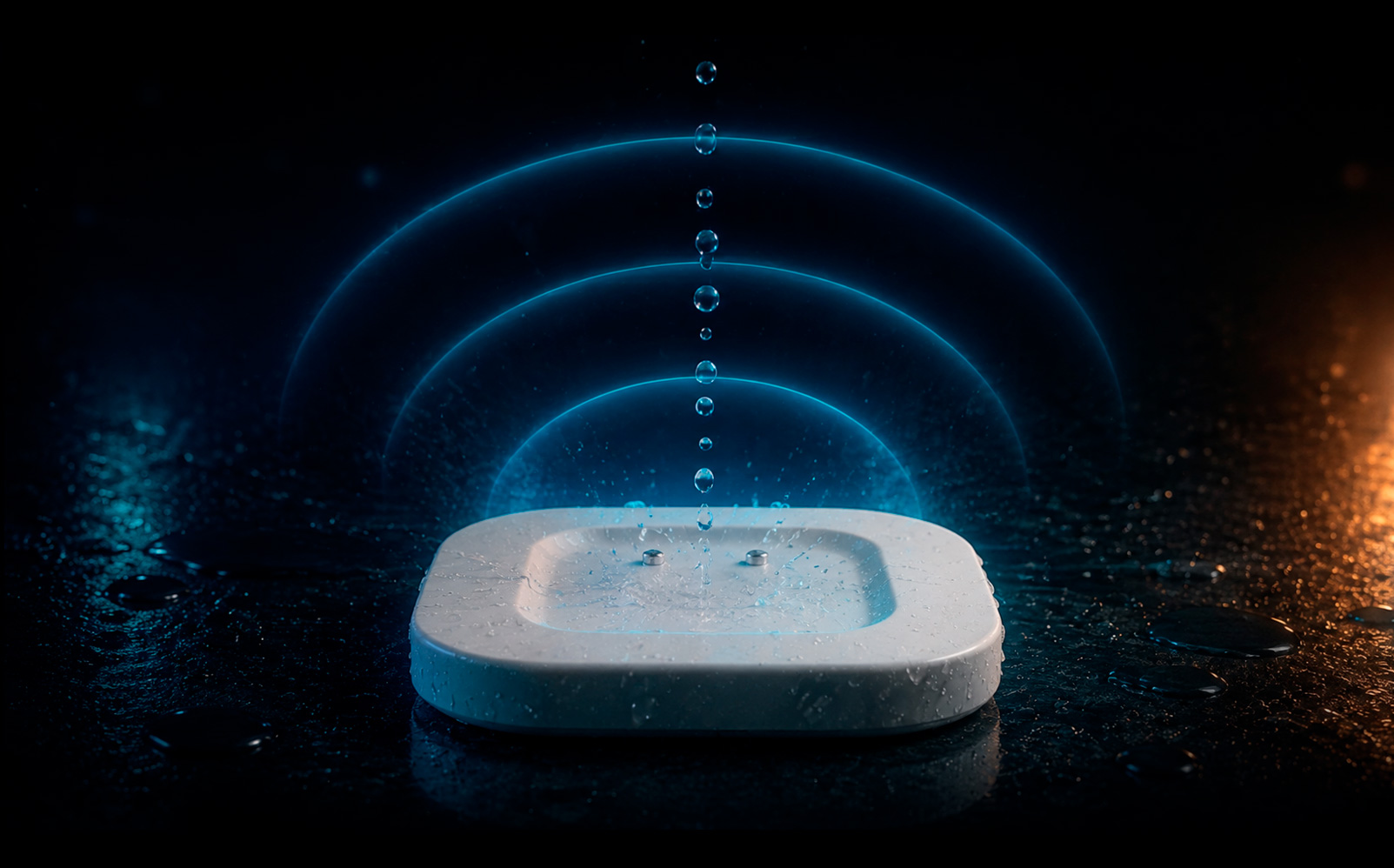
How to choose equipment for a water leak detection system
Choosing equipment for a water leak detection system looks simple at first. In practice, the sensor is only one part of the system. Installation cost, wireless coverage, battery life, gateways, false alarms, maintenance and software can have a much bigger impact on the final result.
At ROOMSYS, we have worked with wired systems, LoRaWAN, Zigbee, BLE and proprietary RF devices. We also tested a lot of hardware that looked good on paper but did not work well in real buildings.
This article is about sensor-based leak detection. Flow-based leak detection is a separate topic and we will cover it in another article.
Wired leak detection
Wired leak detection is simple and reliable. The most common options are dry-contact sensors connected to a controller, or systems integrated with a BMS through BACnet. There are no batteries to replace and no wireless coverage problems.
The main issue is installation cost. Running new cables in an existing building can be expensive, especially when apartments are already finished. In many cases you need to open ceilings, walls or technical areas just to reach the places where sensors need to be installed.
For a new building, wired systems can still make sense. For an existing residential building, they are much harder to justify. Over the last two years, we have almost never selected wired leak sensors for our projects. The technology works well, but wireless systems usually win because installation is much easier and cheaper.
This is something that is easy to miss when comparing equipment. The price of the sensor is only a small part of the total project cost.
LoRaWAN
LoRaWAN is one of the best options we have used for large buildings. Leak sensors send very little data, so the protocol fits this use case well. A typical sensor only needs to send its leak status, battery level, heartbeat and an alarm when water is detected.
With good hardware, coverage can be very good and one gateway can cover a large area. The important part is "good hardware." We tested devices from around six manufacturers before we found equipment that we were comfortable using in real projects.
The problems were very different. Some sensors had poor antennas and much worse coverage than expected. Some had bad battery life. Others had firmware problems or simple functions that did not work correctly, including built-in sound alarms.
Because of this, we do not select LoRaWAN hardware from a datasheet alone. We test the real sensor together with the real gateway, and if possible we test it inside the building where it will be installed.
From our experience, Cora and Dragino devices have been reliable. They gave us good coverage and we did not have major problems with them.
Another advantage of LoRaWAN is the choice of hardware. There are point sensors, rope sensors and many other devices made for different applications. This becomes important in larger projects where one sensor type is not enough.
The main disadvantage is price. In the US, it is difficult to find a good LoRaWAN leak sensor for less than around $15. That is much more expensive than Zigbee hardware.
Zigbee
The main reason to look at Zigbee is price. If you order a large quantity, a simple leak sensor can cost around $5 to $6. There are many manufacturers, although the quality is very different between them.
We tested a lot of Zigbee devices. In practice, Tuya-based hardware usually works well enough for this type of project and the price is hard to beat.
Coverage is the bigger problem. Battery-powered Zigbee sensors do not extend the mesh, so you need powered Zigbee devices to work as routers. Fortunately, this is usually cheap to solve. We often use simple smart plugs as repeaters, and they can help cover areas of an apartment where the direct signal is weak.
Zigbee becomes more complicated when you want one central system for a whole building. Cheap consumer hubs usually depend on the vendor cloud. For our projects, we normally want local communication and one central platform, which means using gateways that can run Zigbee2MQTT or a similar local solution.
These gateways cost more than basic consumer hubs, and you normally need more of them than with LoRaWAN. So a $5 sensor does not mean that the complete system will be cheap. You still need to count gateways, repeaters, installation and maintenance.
BLE
BLE can also work for leak detection. It uses little power and the hardware itself can be cheap, but the real range is not always easy to predict.
The range you see in a datasheet can be very different from what you get inside a real apartment. It depends on the sensor, antenna, gateway position, walls and building materials. We have seen cases where one BLE gateway could not reliably cover one large apartment.
In many cases, direct BLE range is better than Zigbee. The difference is that Zigbee gives you a very cheap way to extend coverage. If one part of an apartment has a weak signal, you can often add a smart plug and use it as a repeater. With BLE, you may need to install another gateway.
The other problem is device choice. There are still not many BLE leak sensors on the market compared with LoRaWAN. This is especially noticeable if you need rope sensors or other special types of leak detection equipment.
BLE makes the most sense when a building already has BLE gateways installed for another system. If you need to build the whole BLE network only for leak detection, the economics are less attractive.
Proprietary RF
We started working with proprietary RF systems more recently. For our US projects, we use 915 MHz devices, and so far the results have been good.
Coverage is lower than with good LoRaWAN hardware. Based on what we have seen in our installations, it can be roughly two times lower. But this does not automatically make the system worse, because the sensors and especially the gateways can be much cheaper.
If an extra gateway is inexpensive, adding another one to improve coverage is not a big problem. In some buildings this can still result in a very good total project cost.
The bigger issue is vendor lock-in. With proprietary RF, the sensor, protocol and gateway usually come from the same vendor. You cannot easily replace one sensor with a device from another manufacturer, and you may also depend on the vendor for firmware, API access and cloud services.
Because of this, we would not buy this type of system from a simple reseller. You need a company with a strong engineering team that can work with the devices and gateways if something goes wrong.
At ROOMSYS, we work with KaaIoT for this part. This gives us an engineering team that can work directly with gateways, device protocols and software when something needs to be changed or fixed.
This was important in one of our projects. We had to work with the Chinese manufacturer to make sure its gateway worked with our software and did not send building data back to servers in China. This took real engineering work and would be difficult for a normal hardware reseller to do.
FCC certification is another important point for US projects. Always check the exact FCC ID for the exact device model you are buying. Do not rely only on a supplier saying that a device is FCC compliant.
Sensor types
There are many types of leak sensors on the market, but in most projects we use only two: point sensors and rope sensors.
Point sensors
Point sensors are simple devices with contacts on the bottom. They work well in places where water should normally never be present, such as under sinks, near toilets, close to water heaters or next to plumbing connections.
They are cheap and easy to install, but placement matters a lot. We do not recommend putting very sensitive floor-level sensors in places where some water on the floor is normal.
Bathrooms are a good example. If the sensor triggers every time there is a small amount of water on the floor, the building team will get too many false alarms. After enough false alarms, people stop paying attention to the system.
Rope sensors
We use rope sensors in places that are difficult to access or where a leak can appear over a larger area. Typical examples are under dishwashers, refrigerators and washing machines, near air conditioners, inside HVAC cabinets or under equipment that is difficult to move.
A rope sensor covers a much larger area than a normal point sensor. This is useful when you cannot predict exactly where water will appear first.
Mats, strips and other sensor types also exist, but in most residential projects we do not use them. They are usually more expensive and do not give enough extra value to justify the price.
Software is a major part of the system
For a residential building, a leak detection system without one central screen is very hard to use. We have seen systems that mainly send SMS messages with apartment numbers. They technically work, but they are not very useful for the maintenance team.
For example, an alert may say: "Leak detected. Apartment 1704." That tells the team which apartment has a problem, but it still does not tell them where the sensor is. It could be under the kitchen sink, behind the refrigerator, under the dishwasher or inside an HVAC cabinet.
This becomes even more important when one apartment has several sensors. An apartment number alone is not enough.
In ROOMSYS projects, we use the real building and apartment plans and place every sensor on the plan in its actual location. The operator can go from the building to the floor, apartment, room and finally the exact sensor.
This saves time and makes the system much easier to use. The maintenance team can see where the problem is before they even enter the apartment.
SMS, email and push notifications are still useful, but they should only be used for alerts. They should not replace the main building interface.
Heartbeat and battery level
A battery-powered sensor should report its status even when there is no leak. We require at least one heartbeat and battery report every day.
The system should always know when the sensor last communicated, what the battery level is, whether a heartbeat was missed and whether the gateway is online.
This matters because a leak sensor may stay in the same place for years without ever detecting water. If the system only receives data when a leak happens, you have no way to know whether the sensor is still working.
A sensor can stop working and nobody may notice for months. A good system needs to detect this before a real leak happens.
What happens after a leak is detected
All of the technologies in this article can also work with automatic water shutoff systems. We normally see this as the second stage of the project, not the first.
Before automating shutoff, the basic leak detection system needs to work well. Coverage must be stable, sensor placement must be correct and false alarms must be low.
If there is a central dispatcher and an audible alarm, a person can first check the event and respond. Automatic shutoff can be added later once the detection system has proven that it is reliable.
The reason is simple. A false alarm is annoying. A false alarm that shuts off water to an apartment is a much bigger problem.
We will cover automatic shutoff and flow-based leak detection in a separate article.
Which technology should you choose?
There is no single best option.
| Technology | Main advantage | Main problem | Good fit |
|---|---|---|---|
| Wired | Reliable | Expensive installation | New buildings |
| LoRaWAN | Best coverage | Higher sensor price | Large buildings |
| Zigbee | Very cheap sensors | More gateways and repeaters | Cost-sensitive projects |
| BLE | Low power | Limited range and device choice | Buildings with existing BLE infrastructure |
| Proprietary RF | Low sensor and gateway cost | Vendor lock-in | Projects with strong engineering support |
Do not start by choosing a protocol. Start with the building.
Look at the number of apartments, where the sensors need to be installed, where gateways can be placed, how much installation will cost and who will maintain the system later.
Also think about what happens when an alarm comes in. Can the maintenance team see the exact sensor location? Can they see when the battery is low? Can they see that a sensor has been offline for several days?
These questions are often more important than the wireless protocol itself.
A good leak detection system needs to do three things well: detect the leak, show the exact location and show that every sensor is still working.
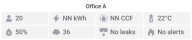
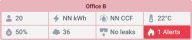
From the first drop to a faster response
ROOMSYS detects leaks in real time and immediately alerts your concierge team—helping them locate the issue, act quickly, and prevent costly damage across the building.
See ROOMSYS in action