Leak detection in restaurant refrigeration: why it matters
What happens if a refrigeration leak goes unnoticed for just a few hours? In most restaurant environments, the answer is not immediate failure – it is gradual degradation. Temperatures begin to drift, compressors work harder, and storage conditions become unstable. By the time the issue is visible, the damage has already affected food quality, equipment performance, and potentially compliance. Refrigeration leaks are one of the most underestimated risks in commercial kitchens. Unlike sudden equipment breakdowns, leaks often develop slowly, making them difficult to detect without continuous monitoring. Refrigerant leaks are a common issue in commercial cooling systems and can significantly reduce system efficiency while increasing operational costs. In food service environments, the impact goes beyond energy – it directly affects food safety.
Read on to understand how refrigeration leaks impact restaurant operations, why they are difficult to detect, and how restaurant temperature monitoring and modern control systems help prevent costly failures.
How refrigeration leaks affect food safety and equipment performance
Refrigeration systems depend on stable internal pressure and consistent refrigerant levels to maintain precise temperatures. When a leak occurs, even a minor one, this balance is disrupted. The immediate effect is reduced cooling efficiency. The system continues to operate, but it struggles to maintain target temperatures. This creates subtle fluctuations that may not trigger alarms in traditional setups but are enough to affect food safety over time. For stored products, this means exposure to unstable conditions. Perishable items such as meat, dairy, and prepared foods are particularly sensitive to temperature variation. Even small, repeated deviations reduce shelf life and increase the risk of spoilage.
At the equipment level, leaks place additional strain on compressors and cooling components. The system compensates by running longer cycles, increasing wear and energy consumption. Over time, this leads to accelerated equipment degradation and higher maintenance costs. In cold storage environments, the impact is amplified. A compromised system affects not just a single unit, but the entire storage space. Without a cold room temperature monitoring system, these changes can go unnoticed until conditions fall outside acceptable thresholds.
Why refrigeration leaks often go undetected
Unlike mechanical breakdowns, refrigeration leaks do not always produce visible or immediate signs. Systems continue to run, temperatures remain close to target ranges, and staff may not notice any obvious issues. Detection becomes difficult because most restaurants rely on periodic checks rather than continuous monitoring. Temperature is typically verified at set intervals, leaving long periods where deviations are not observed.
Several factors contribute to delayed detection:
- Gradual loss of refrigerant that does not immediately trigger system alarms;
- Temperature drift that remains within “acceptable” ranges during manual checks;
- Lack of visibility into compressor behavior and cooling cycles;
- Absence of real-time alerts when performance begins to decline;
- Dependence on human observation rather than automated systems.
These conditions allow leaks to persist over time. Instead of being identified early, they develop into larger problems that affect both food safety and equipment reliability. In multi-unit operations, the challenge increases. Monitoring dozens of refrigeration points manually is not scalable. Each unit becomes a potential risk if not continuously tracked. This is why refrigeration monitoring must go beyond basic temperature checks. It needs to detect patterns – not just thresholds – to identify early signs of system degradation.
Operational and financial risks of undetected leaks
The impact of refrigeration leaks extends across multiple areas of restaurant operations. What starts as a technical issue quickly becomes a business problem. From a food safety perspective, unstable temperatures increase the risk of spoilage and contamination. Products stored under fluctuating conditions may not meet safety standards, even if they appear acceptable. Operationally, leaks reduce system efficiency. Refrigeration units consume more energy while delivering lower performance. This increases utility costs and shortens equipment lifespan.
The financial implications include:
- Loss of inventory due to spoilage caused by unstable temperatures;
- Increased energy costs from inefficient system operation;
- Higher maintenance expenses and unplanned repairs;
- Risk of compliance violations during inspections;
- Potential downtime affecting kitchen operations.
From a compliance standpoint, temperature instability is a key concern. Leaks contribute directly to this issue by making it difficult to maintain consistent storage conditions. Brand impact is another critical factor. Food quality inconsistencies and safety concerns affect customer trust. In a competitive environment, even small deviations in quality can influence customer perception and repeat business. Without structured monitoring, these risks remain hidden until they result in measurable loss.
Detecting and preventing leaks with continuous monitoring systems
Effective leak detection in restaurant refrigeration does not rely on manual inspection alone. It requires continuous monitoring of system behavior and environmental conditions. This is where remote temperature monitoring and advanced commercial refrigeration monitoring systems provide a critical advantage. Instead of relying on periodic checks, sensors continuously track temperature inside refrigeration units and storage areas. Data is transmitted in real time to a centralized platform, where it is analyzed for deviations and patterns. Leak-related issues can often be identified through indirect indicators, such as:
- Gradual temperature drift despite unchanged settings;
- Longer compressor run times or irregular cooling cycles;
- Increased frequency of minor temperature fluctuations;
- Delayed recovery after door openings.
By identifying these patterns early, operators can detect leaks before they result in equipment failure or food spoilage.
This is where ROOMSYS provides a structured solution. Our restaurant temperature monitoring solution enables continuous monitoring across all refrigeration assets. Instead of isolated checks, operators gain full visibility into system performance and environmental conditions. With restaurant food temperature monitoring integrated into a centralized platform, ROOMSYS allows teams to:
Monitor all refrigeration units in real time across one or multiple locations;
Receive instant alerts when temperature behavior deviates from normal patterns;
Analyze historical data to identify early signs of leaks or inefficiencies;
Reduce reliance on manual checks and improve response time.
A cold room temperature monitoring system also ensures that large storage environments maintain stable conditions, even when underlying system performance begins to decline.
Conclusion
Refrigeration leaks are a hidden but critical risk in restaurant operations. They rarely cause immediate failure, but they gradually undermine temperature stability, equipment performance, and food safety. Without continuous monitoring, these issues remain undetected until they result in spoilage, increased costs, or compliance violations. Manual processes are not sufficient to manage this level of risk. Detecting leaks early requires real-time visibility into temperature behavior and system performance. By implementing restaurant temperature monitoring, refrigeration monitoring, and scalable commercial refrigeration monitoring systems, restaurants can identify leaks early, maintain stable storage conditions, and prevent operational losses.
If you need a solution that provides continuous monitoring, instant alerts, and full visibility into your refrigeration systems, contact ROOMSYS to learn how you can detect leaks early, protect your equipment, and ensure consistent food safety across your operations.
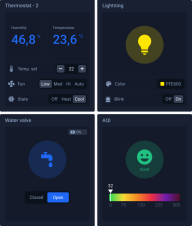
From the first drop to a faster response
ROOMSYS detects leaks in real time and immediately alerts your concierge team—helping them locate the issue, act quickly, and prevent costly damage across the building.
See ROOMSYS in action