Self-storage in 2026: 10 trends operators should be watching
The self-storage industry enters 2026 in a very different position than it was during the extraordinary growth years that followed the pandemic. Demand remains resilient, but operators are now navigating a more competitive environment shaped by slower housing activity, customer expectations, rising operating costs, and increasing technology adoption. At first glance, the market may appear relatively stable. Occupancy remains healthy in many regions, development activity has slowed compared to previous years, and storage continues to demonstrate the resilience that has attracted investors for decades. Beneath those fundamentals, however, important shifts are taking place. Operators are relying more heavily on data, customer experience is becoming a key differentiator, and local market conditions matter more than ever.
Here are 10 trends likely to shape self-storage operations throughout 2026.
1. Local markets will matter more than national averages
One of the biggest mistakes operators can make is assuming national trends accurately reflect local conditions. The self-storage industry has become increasingly fragmented. Migration patterns, housing activity, employment growth, new construction, and local competition vary significantly from market to market. Two facilities located in different regions may experience entirely different operating environments despite broader national trends moving in the same direction. As a result, operators are placing greater emphasis on localized decision-making. Revenue strategies, promotional campaigns, occupancy targets, and pricing adjustments increasingly require market-specific analysis rather than industry-wide assumptions. In 2026, operators who understand what is happening within a three- to five-mile radius of their facilities may have a greater advantage than those relying solely on national forecasts.
2. Technology has become a competitive requirement
There was a time when online rentals, digital payments, and remote access control were considered innovative features. Today, customers increasingly view them as standard expectations. Over the past several years, digital-first operators have helped reshape customer expectations across the industry. Tenants have become accustomed to mobile-friendly rental experiences, self-service account management, automated communication, and contactless transactions. This does not mean every facility needs the most advanced technology stack available. However, operators who continue to rely heavily on manual processes risk creating friction that customers increasingly notice. The competitive conversation is gradually shifting from whether operators should modernize to how effectively they can integrate technology into daily operations. Facilities that remove friction from the rental process are often better positioned to convert and retain customers.
3. Customer experience will influence growth more than ever
Most operators can offer online rentals. Many provide digital payments and automated communication. The real distinction increasingly comes from how customers feel throughout their interactions with a facility. Fast response times, transparent pricing, simple onboarding, proactive communication, and effective problem resolution all influence customer satisfaction and retention. This trend is particularly important because acquiring new customers generally costs significantly more than retaining existing ones. Facilities that create positive tenant experiences often benefit from longer stays, stronger online reviews, and more referral business.
4. Rent growth will continue to normalize
The extraordinary rent increases experienced during the post-pandemic period are unlikely to return in the near future. Across much of the industry, operators have shifted toward more balanced pricing strategies that prioritize long-term occupancy and tenant retention over aggressive revenue growth through frequent rent increases. This does not mean pricing opportunities have disappeared. Rather, operators are becoming more selective and data-driven when implementing revenue adjustments. Many facilities are using analytics to identify specific customer segments, unit types, or market conditions where pricing changes can be applied effectively without increasing move-outs. The focus is increasingly moving from maximizing short-term rate growth to optimizing lifetime customer value.
5. Occupancy remains strong despite market challenges
Although occupancy levels softened in some markets at times during 2025, self-storage continues to demonstrate remarkable resilience compared with many other commercial real estate sectors. Demand drivers remain largely intact. People continue to move, downsize, relocate, renovate homes, start businesses, experience life transitions, and require temporary storage solutions. Importantly, occupancy levels in many markets remain above historical pre-pandemic averages. This highlights one of the industry's defining characteristics: demand may fluctuate, but storage needs rarely disappear entirely. While operators should not expect every market to perform identically, the sector continues to benefit from broad stability in demand, which supports long-term investment confidence.
6. Housing activity will remain a key demand driver
The housing market and self-storage industry remain closely connected. Home purchases, relocations, downsizing, remodeling projects, and household transitions all generate storage demand. Even modest improvements in housing activity can have meaningful effects on facility performance. Most forecasts suggest that housing markets may gradually improve throughout 2026 as borrowing conditions stabilize and transaction activity increases. For storage operators, the significance lies not necessarily in dramatic housing growth but in incremental movement. Small increases in housing turnover can translate into additional move-ins, higher occupancy, and stronger demand for storage services. Facilities located in areas experiencing population growth and housing activity may benefit disproportionately from these trends.
7. Operational visibility is becoming more valuable
Remote management, automated access control, cloud-based software, and digital customer interactions all generate large volumes of operational data. The challenge is turning that information into actionable insight.
Operators increasingly want answers to questions such as:
- Which facilities require attention today?
- Are climate-controlled units operating properly?
- Where are occupancy trends changing?
- Which marketing campaigns generate the highest-value tenants?
- Are maintenance issues emerging before they become costly repairs?
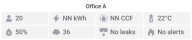
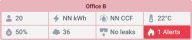
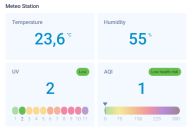
This growing demand for visibility is driving the adoption of business intelligence platforms, centralized dashboards, and IoT monitoring solutions.
8. Automation will continue expanding, but human support still matters
Automated rentals, digital leases, online payments, AI-powered customer support, and remote facility management are becoming increasingly common. These tools improve efficiency and allow operators to scale operations more effectively. However, automation does not eliminate the need for human interaction. Customers still encounter unique situations that require personal assistance. Billing questions, access issues, disputes, and service concerns often require empathy and judgment that technology alone cannot provide. The operators likely to perform best in 2026 will be those who combine operational efficiency with accessible customer support. The goal is not to replace people with technology. The goal is to allow technology to handle routine tasks while staff focus on higher-value interactions.
9. Competition will continue to pressure pricing strategies
High demand does not automatically lead to higher rental rates. In some of the fastest-growing markets, increased development activity and aggressive promotional strategies have created intense competitive pressure. Facilities may experience strong demand while simultaneously facing challenges in maintaining pricing power. This dynamic highlights the importance of market-specific analysis. Operators increasingly need to understand local supply conditions, competitor pricing strategies, promotional activity, and customer acquisition costs before making pricing decisions. Revenue management is becoming more sophisticated as market conditions grow more complex.
10. Agility will be the most important skill in 2026
If there is one theme connecting all of these trends, it is adaptability. The self-storage industry is not facing a single transformative disruption. Instead, operators are managing multiple gradual shifts happening simultaneously: evolving customer expectations, changing technology requirements, local market variations, housing market influences, and increasing competition. Facilities that respond quickly to changing conditions will often outperform those that rely on static operating models. Agility does not necessarily mean making dramatic changes. In many cases, it means continuously evaluating performance, understanding market conditions, leveraging technology effectively, and making informed operational adjustments before problems become significant.
The bottom line: what this means for self-storage operators
The outlook for 2026 is neither overwhelmingly bullish nor pessimistic. Instead, it reflects a maturing industry where operational excellence is becoming increasingly important. Demand remains resilient, occupancy levels remain healthy by historical standards, and self-storage continues to demonstrate many of the characteristics that have attracted investors for decades. At the same time, competition is intensifying, customer expectations are rising, and technology is playing a larger role in day-to-day operations.
Success in 2026 will likely depend less on broad industry conditions and more on how effectively operators respond to their specific markets. Facilities that combine strong customer service, smart technology adoption, data-driven decision-making, and operational agility will be best positioned to capitalize on emerging opportunities. For operators looking to improve visibility across their facilities, optimize operations, and make more informed decisions, ROOMSYS smart self-storage monitoring solutions provide real-time environmental monitoring, centralized dashboards, and IoT-powered operational insights designed for modern self-storage operations.
From the first drop to a faster response
ROOMSYS detects leaks in real time and immediately alerts your concierge team—helping them locate the issue, act quickly, and prevent costly damage across the building.
See ROOMSYS in action