
What is Business Intelligence and why does it matter for self-storage?
For decades, self-storage operators made decisions based largely on experience, local market knowledge, and intuition. While those factors still matter, today's facilities generate far more information than operators can realistically process manually. Every website visit, rental inquiry, payment, move-in, move-out, gate access event, and occupancy change creates data that can reveal how a facility is performing and where opportunities exist. But the challenge is not collecting data – most self-storage businesses already have plenty of it. The issue is turning that information into actionable insights. That is where Business Intelligence (BI) comes in. Once considered a tool reserved for large corporations and institutional operators, BI is becoming increasingly accessible to self-storage businesses of all sizes. By transforming operational data into clear, decision-ready insights, BI helps operators improve pricing strategies, optimize marketing spend, forecast demand, and identify opportunities that might otherwise remain hidden.
What is Business Intelligence?
Business Intelligence is the process of collecting, analyzing, and visualizing business data to support better decision-making. BI helps organizations answer a simple question: what is actually happening in the business, and what should we do about it? Without Business Intelligence, operators often rely on isolated reports, spreadsheets, or assumptions built from limited information. While these methods may provide snapshots of performance, they rarely reveal broader patterns or emerging trends.
A modern BI environment typically consists of three interconnected components:
- Data collection from operational systems and business activities.
- Data analysis that identifies trends, relationships, and anomalies.
- Data visualization through dashboards, reports, and performance metrics.
This process transforms raw information into operational intelligence. Consider a typical self-storage facility. Every day, the business generates data from facility management software, online rentals, customer interactions, occupancy changes, payment activity, marketing campaigns, and environmental systems. Individually, these data points have limited value. Together, they create a detailed picture of facility performance. Business Intelligence connects those dots. Instead of simply knowing that occupancy increased last month, operators can understand which marketing channels drove the growth, which unit types generated the highest revenue, how tenant behavior changed, and whether current trends are likely to continue.
Why self-storage operators are sitting on valuable data
Many storage operators already possess enough data to significantly improve operational performance. The problem is that much of this information remains trapped inside disconnected systems. Facility management software tracks occupancy and revenue. Websites capture visitor behavior. CRM systems record lead activity. Access control platforms generate usage patterns. Environmental monitoring systems collect operational data. Marketing platforms provide campaign performance metrics. Each system contains useful information, but their true value emerges when the data is viewed collectively.
This is where larger operators gained a competitive advantage years ago. Major self-storage REITs invested heavily in centralized reporting, analytics teams, and proprietary data systems. Over time, they developed sophisticated ways to evaluate pricing, identify market opportunities, optimize marketing spend, and forecast demand. For smaller operators, this created an uneven playing field.
Today, however, Business Intelligence tools have become far more accessible. Independent operators no longer need dedicated data science teams to gain meaningful insights from their businesses. Modern BI platforms can consolidate information from multiple systems and present it through intuitive dashboards that support faster decision-making. This shift is particularly important because self-storage markets have become more competitive. Rising operating costs, changing customer expectations, and fluctuating demand patterns mean operators need more precise visibility into performance than ever before.
How Business Intelligence helps improve revenue performance
One of the most immediate applications of Business Intelligence in self-storage involves revenue optimization. Many facilities focus heavily on occupancy rates, but occupancy alone does not tell the complete story. Two facilities may have similar occupancy levels while generating very different revenue outcomes. Business Intelligence allows operators to look beyond surface metrics and understand how revenue is actually being generated. For example, operators can compare potential rental income against actual realized revenue. If a significant gap exists, it may indicate that certain tenants are paying rates below current market levels. Rather than applying broad pricing increases across the facility, operators can identify specific opportunities where revenue adjustments make sense. This type of analysis creates a more strategic approach to pricing management.
BI can also reveal how different unit types perform. Are climate-controlled units generating stronger returns than standard units? Are larger spaces sitting vacant longer than expected? Are specific facility sections consistently outperforming others? These insights help operators make decisions based on measurable trends rather than assumptions. Another important advantage is visibility into customer lifetime value. Not all tenants contribute equally to long-term profitability. Some promotions generate large numbers of move-ins but attract short-term renters who leave quickly. Others may attract fewer tenants initially but produce stronger retention and higher lifetime revenue. Business Intelligence helps operators distinguish between activity and value.
Using BI to improve marketing and customer acquisition
Marketing is one of the areas where Business Intelligence can create some of the most immediate operational improvements. Many self-storage operators invest in websites, search engine optimization, paid advertising, social media campaigns, and listing services. Yet surprisingly few have clear visibility into which channels generate the best results. Without Business Intelligence, marketing decisions often rely on incomplete metrics such as website traffic or lead volume. While these numbers provide useful information, they do not necessarily reveal which campaigns generate profitable customers. Business Intelligence connects marketing activity to business outcomes.
Instead of asking how many leads a campaign generated, operators can ask more meaningful questions:
- Which marketing channels produce the highest-value tenants?
- Which promotions result in the longest average stays?
- Which campaigns generate the strongest return on investment?
Which customer acquisition sources produce the lowest delinquency rates?
These insights allow operators to allocate marketing budgets more effectively. For example, a campaign that generates fewer move-ins may actually outperform a high-volume campaign if the tenants remain longer and generate more revenue over time. Without BI, these differences can be difficult to identify. The same principle applies to website performance. Modern self-storage websites generate extensive behavioral data about how potential customers interact with rental pages, pricing information, and reservation systems. Business Intelligence helps operators understand where prospective tenants abandon the rental process, which pages contribute most to conversions, and what improvements may increase online rental performance.
Forecasting demand and planning more effectively
Self-storage demand rarely remains constant throughout the year. Seasonal moving patterns, housing market activity, economic conditions, and local events can all influence occupancy levels. Operators who understand these patterns gain a significant advantage when planning pricing, staffing, and marketing strategies. Business Intelligence provides the historical perspective needed to identify recurring trends. Rather than reacting to demand changes after they occur, operators can analyze year-over-year and month-over-month performance to anticipate future conditions more accurately. For example, historical occupancy trends may reveal predictable seasonal slowdowns. Marketing performance data may show which promotions consistently improve demand during these periods. Revenue analysis may highlight opportunities to adjust pricing before peak rental seasons begin. Forecasting does not eliminate uncertainty, but it improves preparedness.
This becomes particularly valuable for operators managing multiple facilities. Individual locations often behave differently based on demographics, competition, local economic conditions, and housing activity. Business Intelligence helps identify these differences so operators can make location-specific decisions rather than applying broad strategies across an entire portfolio. The ability to forecast demand also supports more efficient resource allocation. Staffing levels, maintenance planning, marketing budgets, and capital investments can all benefit from a clearer understanding of future business conditions.
How IoT data expands Business Intelligence for self-storage
Business Intelligence is often associated with revenue, occupancy, and marketing data. However, modern self-storage operations increasingly generate another valuable category of information: operational data. This is where IoT technologies are beginning to expand the role of Business Intelligence within the industry. Environmental sensors, HVAC monitoring systems, leak detection devices, occupancy sensors, and energy monitoring platforms generate continuous streams of operational information that traditional facility management software does not capture. When incorporated into Business Intelligence systems, this data provides a more complete picture of facility performance.
Operators can identify recurring HVAC issues before they become major maintenance problems. Environmental monitoring data can reveal temperature or humidity patterns affecting climate-controlled units. Energy consumption trends may highlight opportunities to reduce operating costs. Leak detection systems can provide insights into recurring infrastructure vulnerabilities. Operational intelligence becomes particularly valuable for multi-site operators because it extends visibility beyond financial performance alone. Instead of simply understanding what happened financially, operators gain insight into why certain outcomes occurred and where operational improvements may be possible. This broader perspective is increasingly important as self-storage facilities become more automated, more connected, and more reliant on technology-driven operations.
How ROOMSYS supports smarter self-storage intelligence
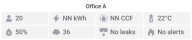
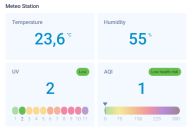
ROOMSYS smart facility monitoring solution helps self-storage operators expand their Business Intelligence capabilities by providing real-time operational data from across their facilities. The platform combines wireless environmental sensors, IoT monitoring infrastructure, automated alerts, and centralized dashboards that provide visibility into facility conditions beyond traditional management software.
For self-storage operators, ROOMSYS can support monitoring of:
- Temperature and humidity conditions;
- Water leaks and moisture risks;\
- HVAC performance;
- Energy usage trends;
- Occupancy and activity patterns;
- Environmental anomalies across facilities.
Because the platform uses wireless IoT architecture and LoRaWAN connectivity, deployment is straightforward even in existing facilities where extensive retrofitting would be costly. The result is a richer operational dataset that can complement traditional Business Intelligence reporting and help operators make more informed decisions about facility performance, maintenance planning, tenant protection, and operational efficiency.
Conclusion
Business Intelligence is no longer a tool reserved for large self-storage REITs or organizations with dedicated analytics teams. As modern facilities generate increasing amounts of operational and customer data, BI is becoming an essential capability for operators who want to compete more effectively. The real value of Business Intelligence lies in its ability to transform information into action. Whether improving pricing strategies, optimizing marketing investments, forecasting demand, or identifying operational inefficiencies, BI helps operators move beyond intuition and make decisions based on evidence.
If you are looking to strengthen operational visibility and expand the data available for smarter decision-making, ROOMSYS smart monitoring solutions provide real-time environmental monitoring, IoT analytics, and centralized facility insights designed for modern self-storage operations.

From the first drop to a faster response
ROOMSYS detects leaks in real time and immediately alerts your concierge team—helping them locate the issue, act quickly, and prevent costly damage across the building.
See ROOMSYS in action