Smart building upgrades that actually improve resident comfort
There are hundreds of things that can be automated in a residential building. That does not mean they should be.
Property managers see a lot of presentations about smart apartments, AI, digital twins, automation and energy optimization. Some of these technologies are useful. A lot of them add cost and complexity without changing much for the people who actually live in the building.
We normally ask a much simpler question: will this make life better for residents, or will it help the building team solve a real problem faster?
In our experience, the things that make the biggest difference are usually quite simple. Stable temperature, early detection of HVAC problems, humidity monitoring, water leak detection and fast maintenance response often give much more value than another app or another complicated dashboard.
And in many cases, the hardware is not expensive at all.
Start with complaints, not technology
Before buying anything, look at what residents are already complaining about.
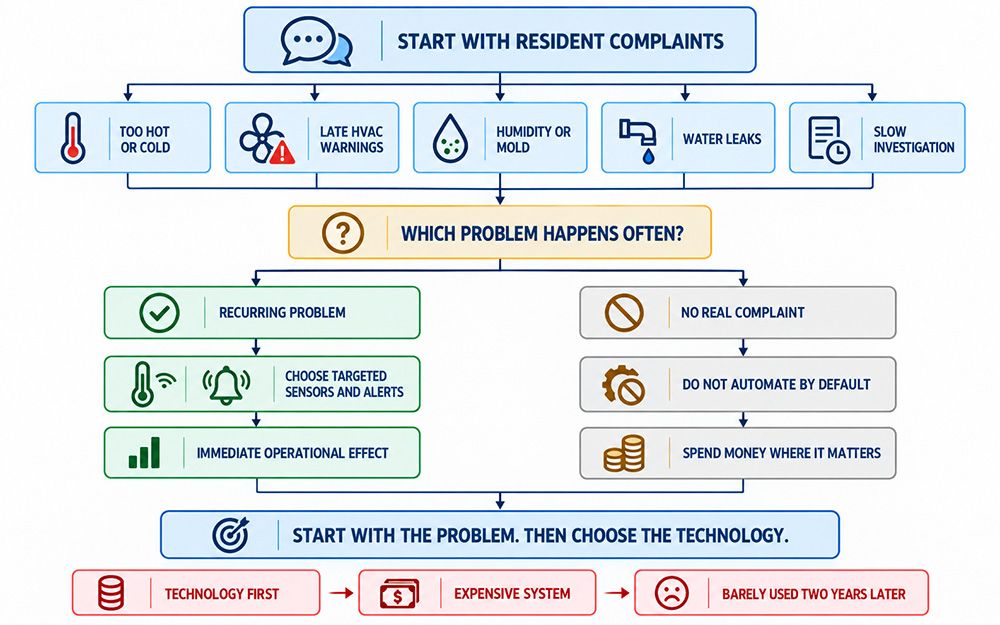
Are some apartments regularly too hot or too cold? Does maintenance hear about HVAC failures only after a resident calls? Is humidity a problem? Have there been mold complaints? Are water leaks common? Does it take too long to understand what happened after somebody reports a problem?
These are good places to spend money. If nobody complains about lighting, a complicated lighting automation project inside every apartment may not change much. If temperature complaints happen every week, a few temperature sensors and good alerts can have an immediate effect.
We prefer to start with the problem and then choose the technology. Doing it the other way around is how buildings end up with expensive systems that looked great during the sales presentation and are barely used two years later.
Catch the problem before the resident calls
One of the best things building monitoring can do is give maintenance time.
We work with a property operator that uses monitoring exactly this way. Their team does not always wait for residents to report a problem. They can see when conditions inside an apartment clearly move outside the normal range and start investigating.
Temperature is a very simple example.
If an apartment reaches 100°F, you do not need artificial intelligence to understand that something is wrong. Maybe the HVAC stopped working. Maybe the thermostat failed. Maybe there is another mechanical problem. The sensor will not tell you exactly what broke, but it tells you that somebody needs to check the apartment.
Without monitoring, the resident may come home, find an extremely hot apartment, get angry and call management. Only then does somebody start looking at the problem.
With monitoring, maintenance may already be working on it. For the resident, that is a huge difference. And this does not require an expensive project. Temperature sensors are cheap. You need a sensible threshold, a central system and somebody who actually sees the alert.
Temperature is one of the easiest places to get real value
Residents notice temperature before they notice almost anything else.
A building may have a highly advanced BMS, but that means very little to someone sitting in an apartment that feels too hot. This is where temperature history becomes especially valuable—not only for residents, but also for the maintenance team.
A resident might call and say the apartment was extremely hot two hours ago. By the time a technician arrives, the HVAC system may be running again and the room temperature may look perfectly normal.
Without historical data, there is very little to investigate. With it, you can see exactly when the temperature began to rise, how quickly it changed, and when it returned to normal.
It is simple information, but it makes a real difference. It helps maintenance teams understand what happened, find the cause, and fix the problem faster.
A lot of problems only need simple rules
There is a lot of marketing around AI-powered building management.
Sometimes advanced models are the right tool. They can help optimize energy use across a large property or find patterns hidden in years of building data.
But many everyday problems in residential buildings are much simpler.
- If an apartment reaches 100°F, send an alert.
- If humidity remains too high for too long, ask someone to check it.
- If a leak sensor detects water, show the maintenance team exactly where it happened.
- If a sensor stops reporting for several days, let them know.
- If a gateway goes offline, send an alert.
None of this requires a complicated model. A few clear rules can often do the job perfectly well.
Simple rules also have one major advantage: everyone can understand them. The property manager knows why an alert was triggered. The maintenance team knows what to inspect. And if a threshold is not quite right, it can easily be changed.
A system does not become better simply because its logic is harder to explain.
In Miami, humidity is not a small issue
Humidity deserves much more attention in Miami and South Florida. Here it is not just a comfort number.
High indoor humidity can create condensation, moisture problems and eventually mold. It can also make an apartment feel uncomfortable even when the temperature looks fine.
This is why we usually monitor temperature and humidity together.
If most apartments are at a normal humidity level and one apartment stays at 75 or 80 percent for a long time, something is wrong.
- It may be an HVAC problem.
- It may be poor ventilation.
- It may be a condensate issue.
There may be water getting into the apartment from somewhere else. The sensor does not need to diagnose the whole problem. It needs to tell the building team that this apartment needs attention.
Again, the hardware for this is cheap. A basic temperature and humidity sensor can provide a lot of useful information if somebody is actually watching the data.
Find the moisture problem before the resident finds the mold
This is especially important with mold.
Once the resident can see mold, the situation is already much worse.
Now it is not a humidity reading on a dashboard.
The resident sees something growing on a wall, ceiling or around HVAC equipment. They start questioning the condition of the apartment. Maintenance needs to investigate. Remediation may be required. Drywall or other materials may need to be opened and replaced.
Even if the original problem was relatively simple, the resident experience is already bad.
This is why we want to see the conditions that can lead to mold before visible mold appears.
For a property manager in Miami, this alone can justify basic humidity monitoring.
The goal is simple: find the moisture problem before the resident finds the mold.
Water leaks quickly become much bigger than a maintenance ticket
Water leak detection is another technology we usually put high on the list. Residents may not notice any daily benefit from a leak sensor sitting under a dishwasher, but they will definitely notice what happens when a leak is missed.
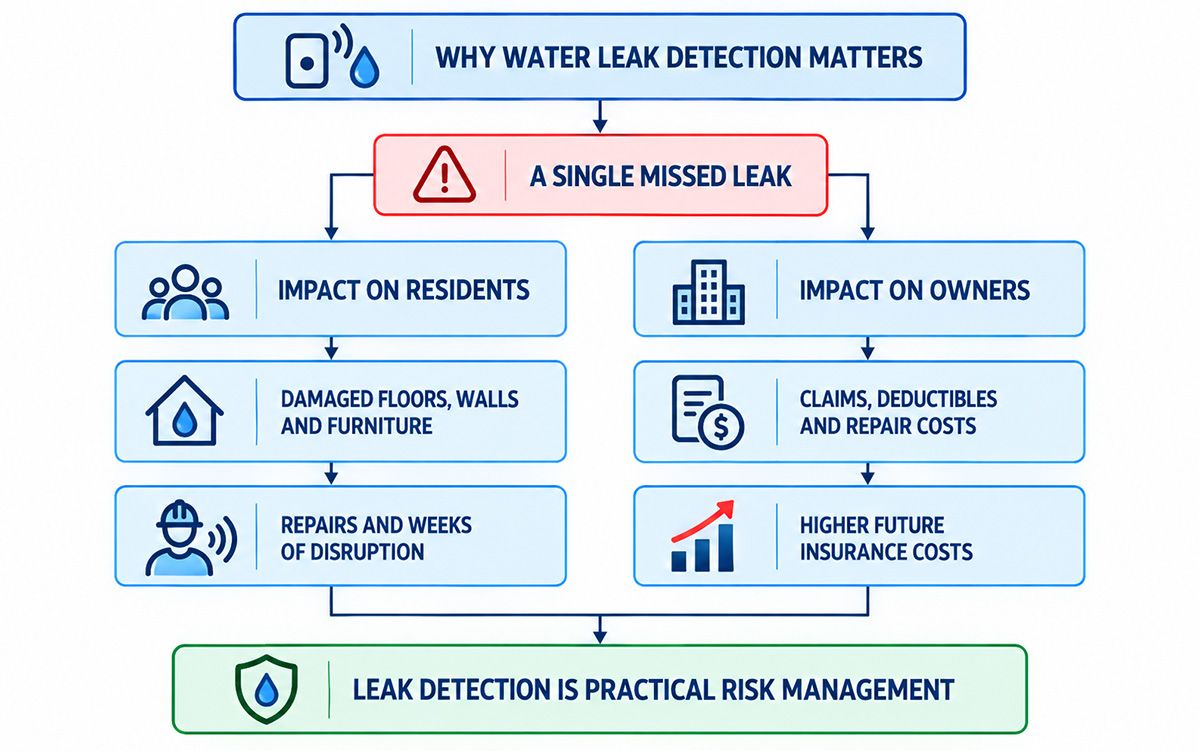
A leak can damage flooring, walls, furniture, and several apartments below. Then come the drying equipment, contractors, repairs, and sometimes mold remediation. For residents, this can mean noise, workers inside their apartments, and weeks of inconvenience.
For property owners, there is another side to the problem: insurance. A serious water event can quickly become an insurance claim, bringing deductibles, repair costs, a claims history, and the possibility of higher insurance costs in the future. In a multifamily property, a single leak can affect several units at once.
That is why we do not see leak detection as just another smart-building feature. It is also a practical form of risk management.
Compare the system cost with the cost of one real leak
When a property manager sees the price of a leak detection system, it is easy to think only about the installation cost.
We think it makes more sense to compare that number with the cost of one serious water event.
- How much does it cost if water damages three apartments?
- How much is the deductible?
- How much does restoration cost?
- How much management time is spent dealing with contractors and residents?
- What happens if mold appears afterwards?
- How much does another insurance claim hurt?
In many buildings, a good leak detection system is cheap compared with one major water incident.
There can also be an insurance benefit. Some insurers take leak detection and automatic shutoff systems into account when assessing a property or may provide incentives for approved systems.
That depends on the insurer and the property, so we would never promise a premium reduction.
But if you are evaluating a leak detection project, insurance should absolutely be part of the discussion.
A leak sensor is only useful if somebody knows where it is
Installing hundreds of sensors is not enough.
We have seen systems that send an SMS such as:
"Leak detected. Apartment 1407."
That is better than nothing, but Apartment 1407 may have ten leak sensors.
The leak may be under the sink, behind the refrigerator, under the dishwasher or inside the HVAC cabinet.
The maintenance team should not have to start searching.
In ROOMSYS projects, we normally place sensors on the actual apartment plans. When something happens, the operator sees the apartment and the exact sensor location.
That can save a lot of time.
For water leaks, every minute can matter.
Fast maintenance is part of resident comfort
People often think of resident comfort in terms of thermostats, lighting, and other features inside the apartment. But the speed of the maintenance response matters just as much.
Imagine two buildings with exactly the same HVAC equipment. In the first building, the system stops working. The resident notices the apartment getting warmer, calls management, and only then does the building team begin investigating.
In the second building, maintenance sees the temperature rising and starts looking into the problem before the resident even makes a call. The equipment is exactly the same, but the second building feels much better managed.
This is one of the most practical benefits of centralized monitoring: it gives the building team something extremely valuable—time.
Air quality sensors are useful only when there is a next step
Air quality is another area where it is easy to buy a lot of sensors without having a clear reason.
You can measure CO2, VOCs, particulate matter and many other values.
Before installing them, ask what happens when the reading is bad.
- Can the ventilation system be adjusted?
- Can maintenance investigate the source?
- Is there an HVAC problem that somebody can fix?
If yes, the sensor may be useful.
If the result is just another graph nobody acts on, it probably is not worth much.
We use the same rule for most building monitoring:
Do not measure something only because you can measure it.
Know what somebody is supposed to do when the value is wrong.
Do not save energy by making apartments worse
Energy optimization is important, especially for HVAC.
But it is very easy to optimize the wrong thing.
A building can reduce energy consumption by letting apartments get hotter in summer or colder in winter.
That does not mean the building became better.
For residential properties, we usually think comfort should define the limits. Energy optimization should happen inside those limits.
The same applies to occupancy-based control.
Reducing HVAC operation in a truly empty apartment can make sense.
Constantly changing the temperature while somebody is home usually does not.
If residents keep overriding the automation, the automation is probably not helping them.
Access has to work every time
Modern access systems can offer mobile credentials, temporary guest access, and remote management. These features are useful, but the system’s most important job is still very simple: the door must open every time.
A system with twenty features that occasionally locks residents out is worse than a basic system that works reliably. There must also be a fallback, because phones run out of battery, internet connections go down, and cloud services sometimes fail.
When technology controls access to someone’s home, reliability matters more than the length of the feature list.
Lighting usually makes more sense in common areas
Lighting automation can work very well in corridors, parking areas, storage rooms and other common spaces.
The building controls these areas, usage is predictable and there is often a clear energy-saving opportunity.
Inside apartments, we usually put it much lower on the list.
Some residents like automated lighting.
Others just want a normal switch.
Unless residents are specifically asking for it, we would normally spend money on temperature, leak detection, humidity and maintenance monitoring first.
A building does not become more comfortable because every light bulb is connected to the internet.
Do not make residents manage the building technology
Another common mistake is giving residents a separate app for every system.
- One app for the thermostat.
- One for access.
- One for lighting.
- Another for building notifications.
Every individual product may work perfectly well.
Together, the experience is terrible.
Residents should not need to understand how the building technology is organized.
If digital controls are provided, keep them simple and keep the number of interfaces as small as possible.
Residents live in the building.
They are not building system administrators.
Maintenance should not need five dashboards either
The same problem happens behind the scenes.
The building team should not have one dashboard for leak detection, another for HVAC, another for temperature sensors and another for gateways.
When something happens, they need one place to start.
The system should show the building, floor, apartment, room and device.
Maintenance also needs information residents should never have to think about:
- Low batteries.
- Offline sensors.
- Gateway problems.
- Missed heartbeats.
- Failed integrations.
A resident should not be the first person to discover that the monitoring system itself stopped working.
Reliability beats features
We would always choose a smaller system that works every day over a huge system where half the features are unreliable.
A smart lock that works 95 percent of the time is a bad smart lock.
A leak sensor that constantly generates false alarms will eventually be ignored.
A temperature sensor that is offline half the time does not help anybody.
Before adding more smart-building features, make sure the existing ones actually work and somebody is responsible for keeping them working.
We have seen buildings get this backwards.
They keep adding new technology while parts of the systems installed a few years earlier are already offline.
More devices do not solve that problem.
Be careful what you buy after a good sales presentation
Property managers are constantly shown impressive smart-building presentations filled with AI, digital twins, predictive maintenance, advanced automation, and enormous dashboards. Some of these technologies solve real problems. Others are mostly marketing.
Before buying anything, ask what will actually change inside the building. Will maintenance learn about HVAC failures sooner? Will the system help prevent water damage or identify high humidity before residents discover mold? Will residents wait less time for repairs? And will the building team actually use the system every day? If there is no clear answer, think carefully before spending the money.
We have seen very simple systems create real value. An inexpensive temperature sensor can warn maintenance that an apartment is approaching 100°F. A humidity sensor can reveal a moisture problem before mold becomes visible. A leak sensor can prevent a small incident from becoming a major insurance claim.
None of this requires a massive technology project. It requires reliable sensors, sensible rules, one place to view the information, and someone who takes action when something goes wrong.
For most residential properties, that is where we would start: temperature and HVAC monitoring, water leak detection, humidity, reliable access, and one central system for the maintenance team. In Miami, humidity would be especially high on that list.
Energy optimization is also worth pursuing, but never at the expense of resident comfort. More advanced apartment automation can come later, when there is a clear reason for it.
Before approving a new system, we usually return to the same questions. What problem are we solving? Will residents notice the improvement? Can maintenance act on the information? Who is responsible when the system itself stops working? And is there a simpler, less expensive way to achieve most of the same result?
Sometimes the right answer is a large building automation project. Sometimes it is a $30 sensor, one sensible alert, and a maintenance team that receives the information early enough to do something about it.
Residents do not care how advanced the technology is. They care that their apartment is comfortable, that water is not coming through the ceiling, and that someone fixes problems quickly.
The best result is when simple monitoring helps the building team find and solve a problem before the resident even knows it exists. That is when the technology is truly doing its job.
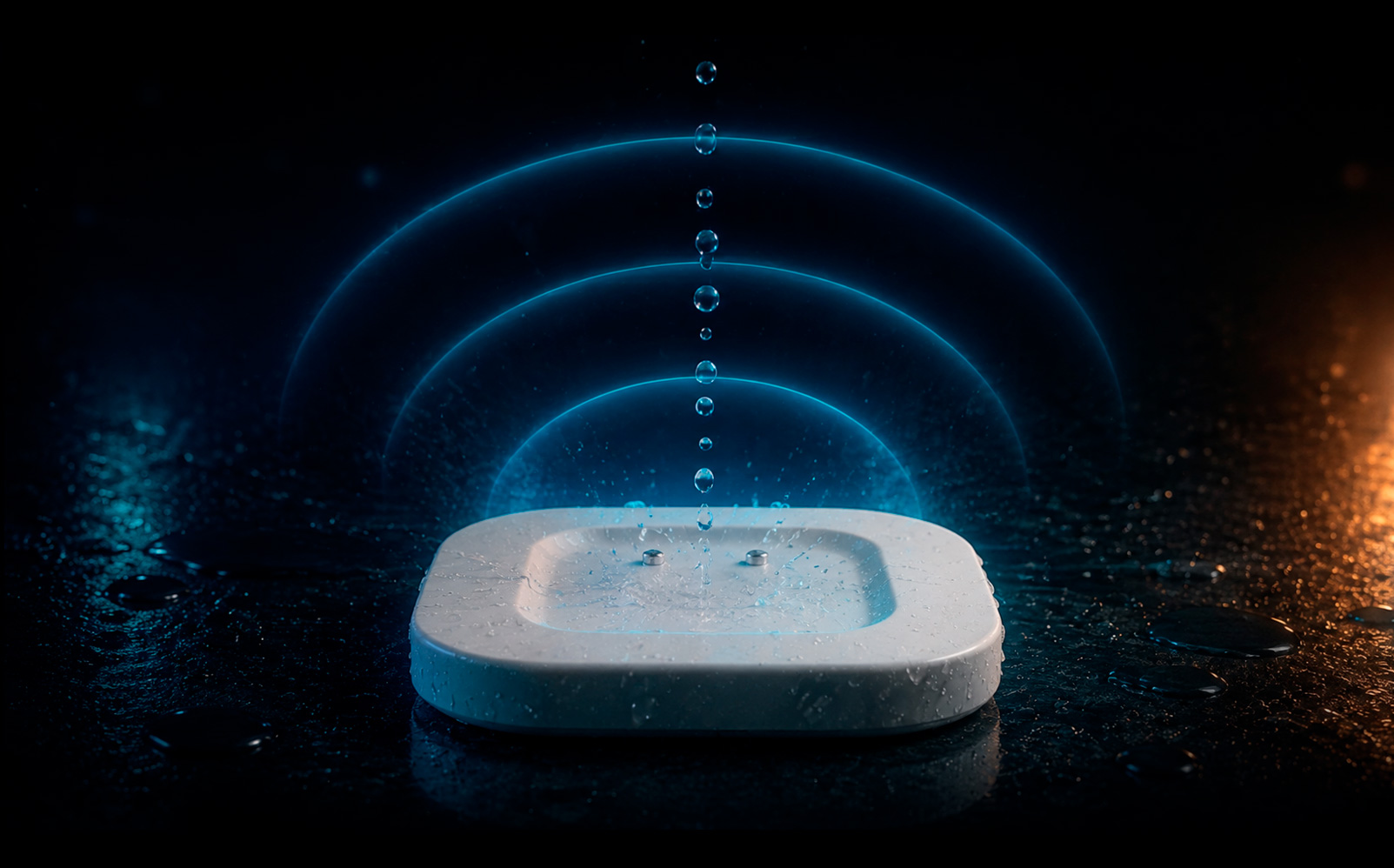
From the first drop to a faster response
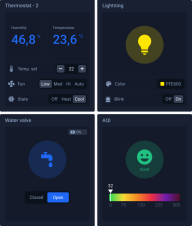
ROOMSYS detects leaks in real time and immediately alerts your concierge team—helping them locate the issue, act quickly, and prevent costly damage across the building.
See ROOMSYS in action